猎场
C919 completes first scheduled international commercial service_我的网站

A |
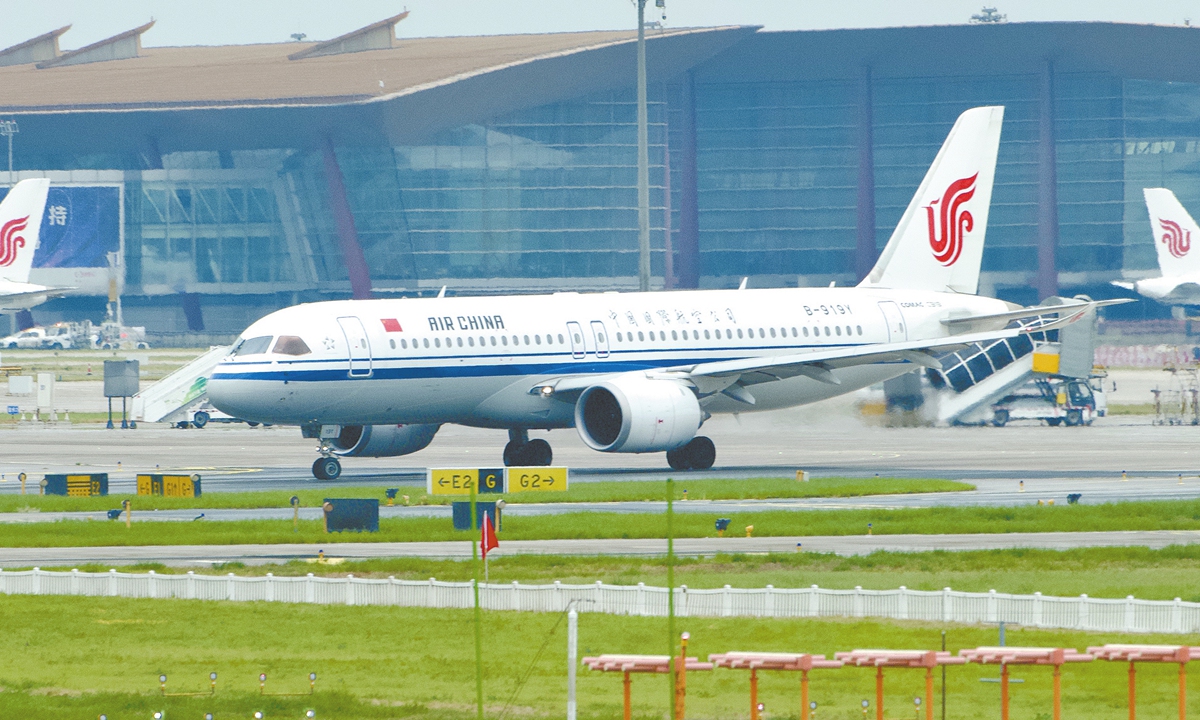
Air China flight CA723 takes off from the Beijing Capital International Airport in Beijing, on August 12, 2026. China launched the first international route featuring its homegrown C919 aircraft, connecting Beijing with Ulaanbaatar, capital of Mongolia. Photo: VCGAt around 4:58 pm on Wednesday, Air China flight CA723, a China-designed and manufactured C919 aircraft carrying 121 passengers, landed in Mongolian capital Ulaanbaatar, marking the latest milestone in the C919's commercial operation since its maiden commercial flight on May 28, 2023. The journey, which started in Beijing, was more than another takeoff, as it marked the C919's first international commercial flight and the beginning of regular international operations for China's homegrown large passenger aircraft.
As the C919 climbs higher and flies farther beyond China's borders, the runway behind it gradually disappears. What comes into focus instead is a much broader journey - one in which China's advanced engineering capabilities are reaching new markets, new partners and new possibilities around the world.
Historic momentHours before takeoff, a passenger surnamed Zhang, who was completing check-in procedures at Beijing Capital International Airport, said with a smile that he had stumbled into a "historic moment" by chance.
"I didn't pay much attention when I booked the ticket. I had heard that our homegrown C919 would soon begin international service, but I never expected it would be this very flight," Zhang told the Global Times on Wednesday. "I feel incredibly proud and excited."
From its maiden flight in Shanghai in 2017, when its first takeoff had many watching with bated breath, to its first scheduled international commercial service today, the C919's journey reflects China's sustained push to build up its capabilities in advanced aviation manufacturing.
In recent years, China's top-level policies have strongly supported the development of high-end manufacturing. As the nation enters the opening year of the 15th Five-Year Plan period (2026-30), Chinese high-end manufacturing is increasingly translating technological breakthroughs into globally competitive products and solutions to contribute more broadly to industrial development and connectivity worldwide, Chinese experts noted.
And the C919 program is one of China's most ambitious endeavors to push the frontiers of high-end manufacturing.
The C919 is China's first self-developed trunk jetliner in accordance with international airworthiness standards and registered with independent intellectual property rights, according to the Xinhua News Agency on Wednesday.
Industry experts said the C919's progress reflects the rapid advance of China's broader manufacturing capabilities. Only a handful of countries are capable of developing single-aisle mainline passenger jets, and even fewer can bring a certified aircraft into commercial service.
The C919 aircraft's biggest achievement is that China has built the capability to take a large passenger jet from the drawing board all the way to a certified commercial product, covering overall design, airframe manufacturing, system integration and airworthiness approval, Wang Ya'nan, editor-in-chief of Beijing-based Aerospace Knowledge magazine, told the Global Times on Wednesday.
Much of the aircraft's design, major structural manufacturing and key systems are completed in China. He said this marks a significant step forward in China's civil aviation manufacturing capability, placing the country among the few able to develop a modern trunk-line jet and bring it into commercial service. Its expanding operations now represent the next stage of that progress, he added.
As of Monday, the C919 aircraft had served 57 routes linking 25 cities and handled more than 7.5 million passenger trips, said the Commercial Aircraft Corporation of China (Comac), the jet developer, according to Xinhua.
However, the C919 still faces intense competition in a global market dominated by established players. Experts said, however, that its competitiveness could continue to strengthen as operational experience grows and China accelerates indigenous development of key components and systems.
The UK-based aviation industry publication Airline Economics noted on July 13 that Malaysia Airlines continues to consider Comac's C919 as a future fleet option, but Western regulatory certification remains a key requirement before the carrier would consider operating the Chinese narrowbody.
This has also brought into sharper focus the dual considerations of certification and market demand among potential international customers for the C919, as Wang said this is precisely why the C919's continued expansion into new routes and markets matters.
As cross-border services expand, the C919 will also need to move closer to international operating standards by building a support network that goes beyond its domestic maintenance system to cover the full cycle of international operations, including regulatory coordination, overseas maintenance facilities and spare-parts logistics, Han Tao, an expert with China's civil aviation think tank, told the Global Times on Wednesday.
Strengthening these capabilities will be crucial to supporting more international routes and meeting the standards and operational needs of potential overseas customers, Han said.
Meanwhile, industry observers noted that China is also stepping up efforts to advance key components and systems for large commercial aircraft, an area that remains a major challenge for most countries' aviation industries, with mature capabilities still largely concentrated in the US, the UK and France.
Pushing boundaries, sharing opportunitiesAs the C919 flies farther, it is carrying with it not only China's advances in high-end manufacturing, but a broader story of how Chinese innovation is moving from breakthroughs at home to new possibilities shared with the world.
Underpinning that shift is China's expanding advanced manufacturing capacity and increasingly complete industrial ecosystem, which are helping turn technological breakthroughs into scalable products, a Chinese expert said.
China is upgrading its traditional industrial base while cultivating new sectors that could shape future competitiveness, seeking to move beyond scale and cost advantages toward a more innovation-driven industrial model, injecting new impetus into the country's high-quality development, according to Xinhua's another report on July 21.
The nation's 15th Five-Year Plan underscores the development of a modernized industrial system with advanced manufacturing as its backbone, the report said.
China's vast and diverse market provides advanced manufacturing with something equally important as technological capability: abundant real-world scenarios for testing, refinement and commercialization, Bian Yongzu, executive deputy editor-in-chief of Modernization of Management magazine.
This helps turn breakthroughs into mature, scalable products more quickly. Over the longer term, he said, advanced manufacturing will strengthen China's competitiveness by combining stronger industrial capabilities with complete supply chains and global cooperation, allowing more Chinese technologies, products and solutions to reach international markets, Bian said.
Aviation manufacturing, as a key pillar of high-end manufacturing, is benefiting from this broader push toward industrial upgrading and technological innovation.
At the fourth China International Supply Chain Expo held in Beijing in June, a complete aviation industry innovation chain stands out, spanning aviation materials, core forgings and low-altitude economy applications, drawing widespread attention to the participating companies, Xinhua reported.
Bian said that a complex project such as the C919 can drive coordinated upgrades across advanced materials, precision equipment, core components, system integration, logistics and skilled talent. In this sense, building a large commercial aircraft is a comprehensive test of a country's industrial depth, supply-chain coordination, and ability to turn sophisticated technologies into reliable commercial products.
。

B | 一位曾在Rockstar Games任职的资深开发者认为,近期大规模泄露的《GTA 6》片段不过是"小题大做",因为绝大多数最终购买并游玩这款作品的玩家,并不会像部分网友那样在网上疯狂搜寻这些泄露的两分钟短视频。过去一周,一位网名为Cyberleek的黑客持续在网上泄露《GTA 6》的开发片段,据称其目的是推广自己的加密货币项目,并向Rockstar Games施压以保护玩家数字权利。母公司Take-Two对此显然高度重视,但曾在《GTA 4》等作品中担任技术总监的Obbe Vermeij却给出了截然不同的判断。

C | "大家都冷静点,"他在社交媒体上发文称,"这些泄露根本没什么大不了的。"Vermeij解释道,Rockstar对其旗舰作品的保密周期"比其他发行商更长",这本身就是一种营销策略——神秘感制造热度。

D | 而"现在发生的不过是一些片段外泄罢了"。他表示,如果《GTA 6》已经按照常规营销节奏发布了实机预告片,那这些泄露在大局上根本算不上什么新内容。"90%的未来玩家不会花时间在网上搜寻视频片段,"Vermeij继续说道,"他们既没时间,也不想被剧透。我猜想开发团队对此可能有点恼火,但也仅此而已。"他以自己亲历的"热咖啡"(Hot Coffee)事件作对比——该事件涉及《GTA:圣安地列斯》中意外遗留的成人小游戏代码。"那件事对管理层(Rockstar纽约办公室)来说是噩梦,但对我们(Rockstar North)影响不大。当前的泄露远比'热咖啡'事件的后果轻微。《GTA 6》看起来将会非常出色,未来15年左右都会持续热销。

E | 这些泄露不过是一个微不足道的小插曲。"不过情况也有微妙变化。就在几天前,Cyberleek发布的片段暗示其手中握有实际可玩的游戏版本,一旦该版本被完整放出,事态可能会变得复杂。对此Vermeij表示,该版本"很可能只能在开发套件上运行",因为开发机的内存容量远超普通Xbox、PlayStation或PC:"目前很可能根本不存在能在零售版PS5上运行的构建版本。

F | "
本文由游民星空制作发布,未经允许禁止转载。更多相关资讯请关注:GTA6专区。
Current article:http://zhc.shengyaodanrongchui.buzz/news/20260826_9197.html
Published on:18:21:59


 Chinese, foreign visitors join millennium-old folk celebration in Qinghai
 重庆宝妈摆摊救娃后续:捐款5万博主自曝拍摄内情,当地社区回应
 我省对校园食品安全工作进行再部署再要求
 科技破局金融赋能 山东威海做强蓝色产业,科技破局金融赋能 山东威海做强蓝色产业
 河北省公开征集遴选养老服务专家
 《湮灭之潮》女主脸又变回去了?预告片疑有两个形象